7 Day Trek From The Ocean links Old Dragon’s Head, Huangyaguan, Jinshanling, Gubeikou, Jiankou. The program balances walking, transfers, meals and overnight arrangements across a longer section of the Wall.
Summary
7 Day Trek From The Ocean links Old Dragon’s Head, Huangyaguan, Jinshanling, Gubeikou, Jiankou. The program balances walking, transfers, meals and overnight arrangements across a longer section of the Wall.
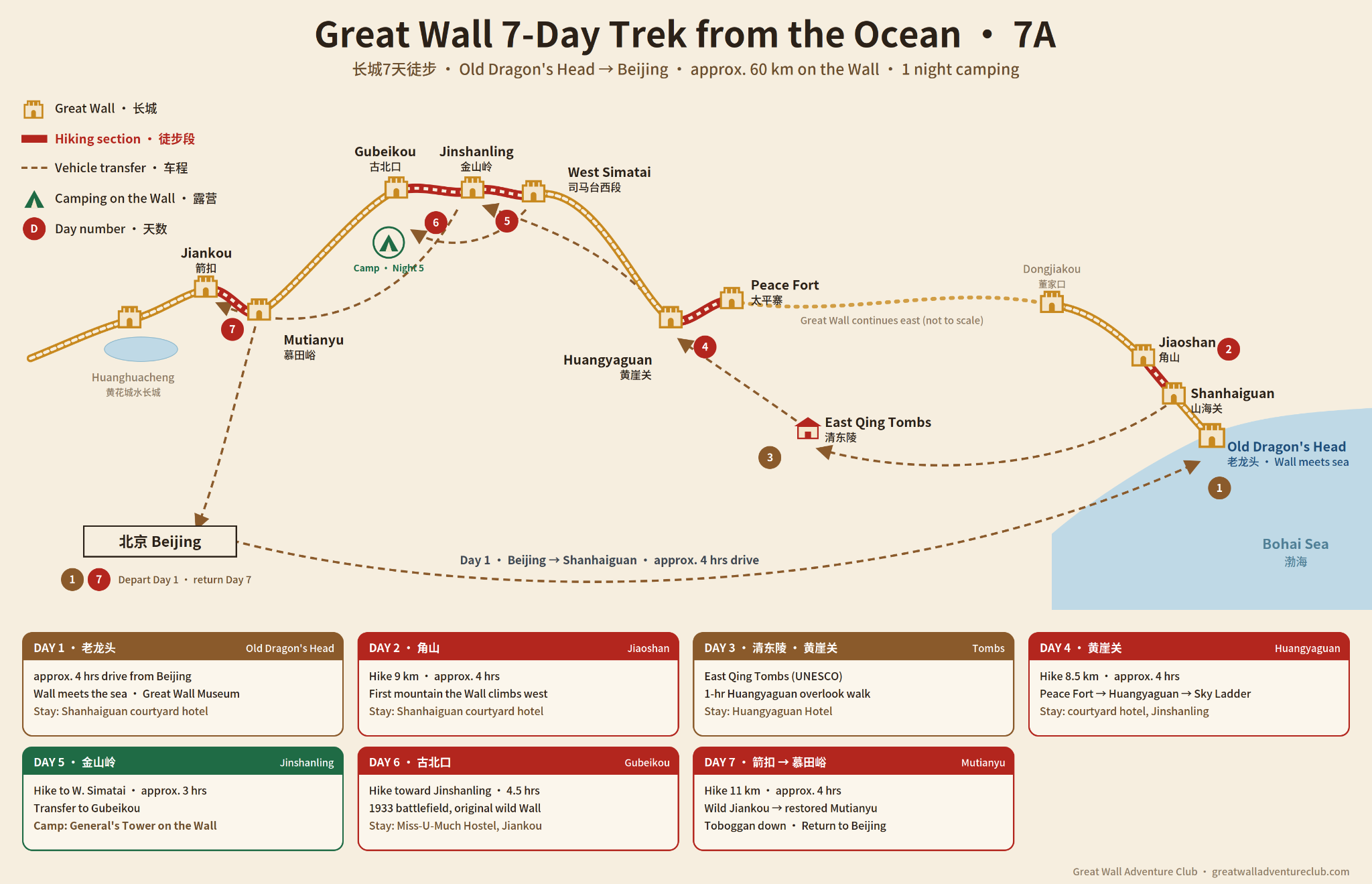
Route map
Route illustration. Your guide will confirm the final trail, access and travel times before departure.
Brief itinerary
Day 1 · Old Dragon's Head
Day 2 · Jiaoshan
Day 3 · East Qing Tombs to Huangyaguan
Day 4 · Peace Fort to Huangyaguan and Sky Ladder
Day 5 · Jinshanling to West Simatai
Day 6 · Gubeikou-Jinshanling
Day 7 · Jiankou-Mutianyu
Detailed itinerary
Day-by-day route details from our original tour program. Confirm the departure time, walking distance, meals, lodging and permitted campsite in your booking proposal; these may change with access and weather.
Day 1 · Old Dragon's Head
We will make the 4-hour drive to the Old Dragon's Head and Shanhaiguan Pass, the First Pass Under the Heaven. We will start our hike at Old Dragon’s Head, also known as Laolongtou.
We will enter the Shanhaiguan Great Wall Museum, where we will learn about the history and military strategy of this section of the wall and display military relics. After dinner, you will tour the Old Town of Shanhaiguan.
Meals: Breakfast, lunch, dinner
Accommodation: Shanghaiguan Hotel or similar
Day 2 · Jiaoshan
We'll explore Jiaoshan. The Jiaoshan Peak is two miles away from Shanghaiguan. Though relatively diminutive in size, this is the first actual mountain the Great Wall passes heading west, known as “the first mountain of the Great Wall.” Jiaoshan ancient wall provides you a sense of historical vicissitude. The wall appears more and more crumbled and deformed as you forge ahead. We will drive to Dongjiakou Great Wall and overnight there.
Walk: 9 km
Hours: 4
Meals: Breakfast, lunch, dinner
Accommodation: Shanghaiguan Hotel or similar
Day 3 · East Qing Tombs to Huangyaguan
We will make the short trip to the East Qing Tombs. which is among the finest, best-preserved, and largest of the extant tomb complexes in China. Five emperors, four empresses, five imperial concubines, and one princess are arrayed based on the traditional concept of placing the most senior and most distinguished in the center.
We will also walk the Huangyaguan Great Wall and the fortress where there is a Bagua pattern, a specially designed labyrinth designed to confuse and entrap the enemy.
Meals: Breakfast, lunch, dinner
Accommodation: Huangyaguan Hotel or similar
Day 4 · Peace Fort to Huangyaguan and Sky Ladder
Today we'll start with Peace Fort (Taipingzhai) that begins from Banlagang Mountain in the east and arriving at Guafu Tower (Widow Tower) in the west. There are six watchtowers, one battlement, and one shortcut leading to the wall.
Waking westward, we will get to the steepest segment of this section, the Huangya Sky Ladder. This long stairway stretches to the top of the ridge, seemingly leads to the sky. Climbing over the ladder, we will reach the primitive Great Wall built in the Northern Qi Dynasty, marking the end of the Huangyaguan section.
We will drive to Jinshanling to sleep tonight.
Walk: 8.5 km
Hours: 4
Meals: Breakfast, lunch, dinner
Accommodation: Huangyaguan Hotel or similar
Day 5 · Jinshanling to West Simatai
Our hike will start from Simatai, and we will make our way west along the Wall into Jinshanling. It is the classic Great Wall that can make every hiker thrilled. The Wall runs from a deteriorated wild state to the restored in the end to allow hikers to compare the differences between the two wall status.
Tonight, we will camp on the Great Wall in an ancient watchtower.
Meals: Breakfast, lunch, dinner
Accommodation: Camping on the Wall
Day 6 · Gubeikou-Jinshanling
Gubeikou is mostly Wild Wall. It was first built during the Northern Qi Dynasty (550-557) and rebuilt in Ming Dynasty (1368-1644). The Wall zig-zags for about 40 kilometers with 172 watchtowers, 14 beacon towers, 16 passes, 3 water passes, 3 barbarians, and 6 fortresses along with it.
In 1933, the Chinese army fought against Japanese invasion troops at Gubeikou. In the four-month-long battles, they killed over 5,000 enemy soldiers at the price of 9000 Chinese soldiers died. You can see that Gubeikou is not merely a relic, but it remained a battlefield in the modern world.
We will transfer to Jiankou in the late afternoon.
Meals: Breakfast, lunch, dinner
Day 7 · Jiankou-Mutianyu
From Jiankou we will cross over onto Mutianyu, a section of the Wall that has been largely restored. Although it has gotten a face-lift, it avoids the army of tourists that plague Badaling. Mutianyu offers some breathtaking views of the valley and wall below, and if you look to your right, you’ll see a large sign engraved in the side of the mountain, encouraging you to “Cherish the teachings of Chairman Mao.” Mutianyu has also become famous for visiting foreign leaders and celebrities.
We will end our 7-day trip this afternoon.
Walk: 11 km
Hours: 4
Meals: Breakfast, lunch
What we confirm
Meeting point and departure window
Admissions, tickets and local transport
Guide language, meals and accommodation
Walking level, luggage and weather plan
Return point or onward connection
Before you proceed
Share the relevant dates, group size and priorities. We will provide the current details in writing and identify anything that must be booked separately or may change with access, schedules or local conditions.
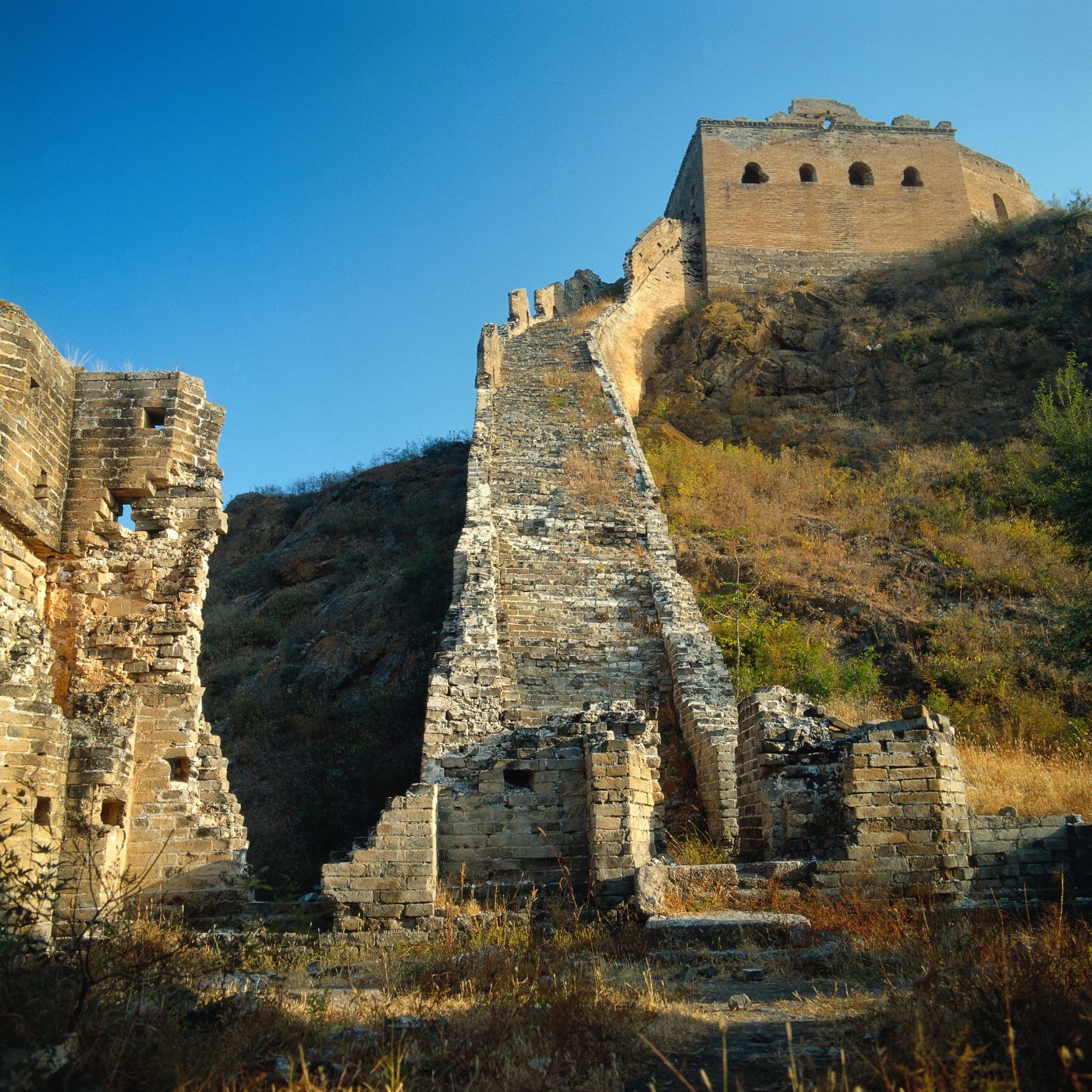
Original Great Wall stonework and watchtowers — from the Great Wall Adventure Club source site.
What makes this experience different
More than a viewpoint
Walk tower to tower and understand how the Wall follows the natural defense line.
A route for your pace
We distinguish gentler restored paths from demanding unrestored ridges before you choose.
Local route knowledge
Entrances, exits, seasonal conditions and transfer logistics are checked for your date.
TerrainStone steps, ridges and uneven historic paths
Best seasonsSpring and autumn; summer and winter need extra planning
BringGrippy footwear, water, layers and sun protection
Designed around real travelers
Every departure is matched to the group’s dates, ages, interests, walking experience and preferred comfort level. Tell us what matters most—quiet trails, photography, history, a physical challenge, family time or a broader China itinerary—and we will explain the most practical options without hiding the tradeoffs.
Questions worth asking before booking
How much time is spent walking, driving and stopping?
Which parts of the route are restored, unrestored, steep or exposed?
What is included, and what should we carry or arrange ourselves?
What changes if weather, access rules or transport schedules affect the plan?
Keep exploring
Compare more multi-day treks or talk to us about a custom route.