|
You will be picked up at your Beijing hotel by
your English-speaking guide and driver between 7:30-8am. From there
we will make the drive to the
Lianhuachi Great Wall.
The
Lianhuachi Great Wall is
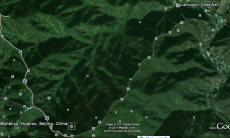
located south of Lianhuachi (Lotus Pond) Village in Yanqi Town. The
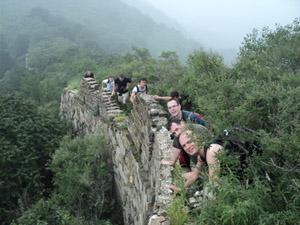
ancient Wall here zigzags into mountains that are now decorated with
trees turning green and wild flowers that have just blossomed.
Locals also call this pass Queliang-"lacking grain". Some say Qilian
comes from the name of a leader who built the wall here, while "Queliang"
came about due to the difficulties of building the wall, when
soldiers often lacked grain and worked while hungry.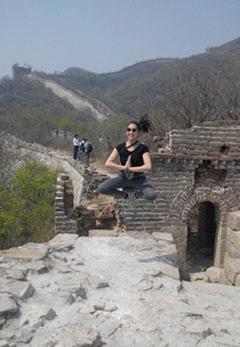
According to ancient records, the Lianhuachi Great Wall was built
during Emperor Yongle’s reign during the Ming Dynasty (1368-1644).
The Pass was connected with the Mutianyu Great Wall on one side and
Shentangyu Great Wall on the other. The walls to the north of the
Lotus Pool were mostly built with stones. In some steep parts, only
hollow watchtowers were constructed. The section from the Lotus Pool
to the Mutianyu Great Wall in the
southwest was built with both bricks and rocks.
Qilian Pass once had a gate, with two large cannons guarding it from
the outside. The gate was demolished and the cannons were taken away
in the 1970s to make way for a road. A bridge was also built over
the pool. However, two beacon towers remain on each side of the
pass. The Lotus Pond section features beautiful mountain landscape.
In April, trees have turned green and wide flowers are blossoming.
Spring and autumn are the best seasons for climbing the wall. In
September and October, the mountains around Qilianguan Great Wall
begin to turn like the color of changing leaves.
After a few hours of hiking the Lianhuachi Great Wall we will cross
over into the Great Wall of Mutianyu, a
section of the wall that has been largely restored. Although it has
gotten a face-lift, it avoids the army of tourists that plague
Badaling. Mutianyu offers some breathtaking views of the valley and
wall below, and if you look to your right you’ll see a large sign
engraved in the side of the mountain encouraging you to “Cherish the
teachings of Chairman Mao”. Mutianyu has
also become popular for visiting foreign leaders and celebrities
(former U.S. President Clinton and UK Prime Minister John Major
visited Mutianyu on one of their trips to China). From Mutianyu you
will have the opportunity to see the sunset from the Great Wall, an
event that is sure to be one of the major highlights on your China
trip.
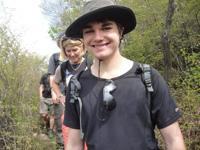
You can hike down to the parking lot, take a cable car, or take a
toboggan ride (highly recommended, and lots of fun!) down. From
there we will drive back to Beijing. Many hikers wanted us to stop
by the Olympic Green on the way back to Beijing to take pictures of
the famous Bird's Nest and the Olympic Green, the center of the
event that captivated the world for two weeks in August of 2008, and
is where a majority of the Olympic events took place.
The highlights that you will see today include the Bird’s Nest
(officially known as the Beijing National stadium) and the Water
Cube (the Beijing National Aquatics Center). The stadium gets its
nickname from its outward design, which originated from the study of
Chinese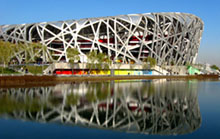 ceramics, implementing steel beams in order to hide supports for the
retractable roof, thus giving the stadium the appearance of a
"Bird's nest". The Bird’s Nest hosted the Opening and Closing
Ceremonies, athletic events, and football final of the 2008 Summer
Olympics, from 8 August to 24 August 2008. Since the Olympics' end,
the Bird’s Nest has been used to host events ranging from opera to a
ski park.
ceramics, implementing steel beams in order to hide supports for the
retractable roof, thus giving the stadium the appearance of a
"Bird's nest". The Bird’s Nest hosted the Opening and Closing
Ceremonies, athletic events, and football final of the 2008 Summer
Olympics, from 8 August to 24 August 2008. Since the Olympics' end,
the Bird’s Nest has been used to host events ranging from opera to a
ski park.
At about 5 pm, we'll send you back to your hotel or drop you to a
location for your own dinner. If you want us to recommend you a nice
Chinese restaurant, please ask your guide.
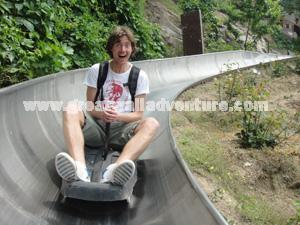
Mutianyu Toboggan (German technology)
|
Toboggan Run at Mutianyu
(extra for RMB50)
You'll surely be intrigued about taking the toboggan down
from Great Wall to the entrance gate down the hill. You can
ride as fast or as slow as you want. However, it is also a
driving test. One person to a toboggan, you have a little
handle with which you press down to go faster and pull up to
stop. But if you are not intentionally pushing it, it will
slow down anyway. "It is funny when we Westerners are on
there, because we like to go a bit quicker than the Chinese
(read a lot quicker) and you hear the shrill voices of
locals shouting "brake! brake! Slow down!" It is hilarious.
Go on it even if it is just to hear that." --taylorstonebridge
on LonelyPlanet
People at age 70 have managed the riding successfully. Can
you?
|
|





 Check
Check
 Read
complete itinerary of Route 1A:
Read
complete itinerary of Route 1A: 
