|
Beijing
One-day Private Tour with Lunch
Tian'anmen Square, Forbidden City,
Temple of Heaven, and Summer
Palace
| |
PRIVATE TOUR ITINERARY |
 |
Tour
code:
GWA-BJ-102 |
|
Please join us for a tour of Beijing's (and all of
China’s) most iconic and culturally significant
landmarks!
MORNING
At 8:00 am we will pick you up from your hotel and
drive directly to Tian’anmen Square. The largest
open
public square in the world at 440,000 square
meters, Tian’anmen has long been seen as the
political center of China. It was from the Gate of
Heavenly Peace overlooking the square where in 1949
Mao Zedong proclaimed the founding of the People’s
Republic of China. The Square has seen some
turbulent moments, such as the May 4th Movement of
1919 (where Chinese intellectuals protested the
transfer of Shandong Province from the Germans to the
Japanese), the protests during the mourning for
Premier Zhou Enlai in 1976, and of course the
political turmoil of 1989.Tian’anmen square as it is
presently constructed was completed in 1959 to mark
the 10th Anniversary of the People’s Republic of
China. On the east side it is flanked by the
National Museum of China (presently closed but due
to re-open in late 2010), on the west side by the
Great
 Hall of the People (home to the National
People’s Congress and the Chinese People’s
Consultative Conference) to the south by the
Chairman Mao Memorial Hall, and to the north by the
Gate of Heavenly peace, the iconic symbol of New
China. North the middle of the square stands the
Monument to the People’s Heroes. Hall of the People (home to the National
People’s Congress and the Chinese People’s
Consultative Conference) to the south by the
Chairman Mao Memorial Hall, and to the north by the
Gate of Heavenly peace, the iconic symbol of New
China. North the middle of the square stands the
Monument to the People’s Heroes.
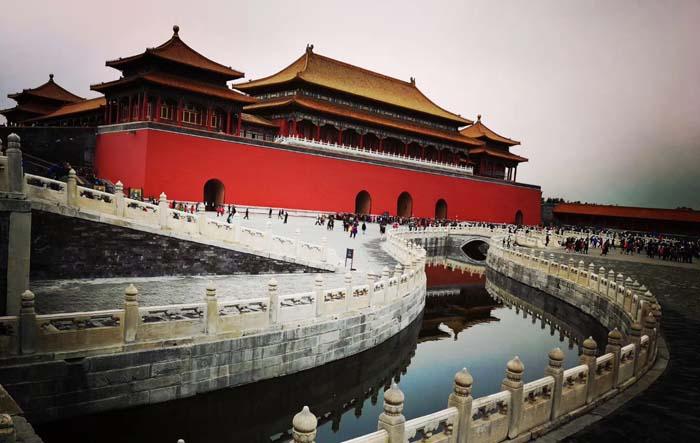
After strolling across the square we will then visit
the Forbidden City (known in Chinese as Gu Gong),
the most famous and popular attraction in China, and
probably in all of Asia. It was the main imperial
palace used by the Ming and Qing dynasties.
Originally built between 1406 and 1422 by the third
Ming emperor Yongle, the palace complex houses 980
buildings with 8,707 bays of rooms. After the last
emperor, Puyi, was finally evicted in 1924, the
Palace Museum was established to watch over the
Forbidden City. The Forbidden City is the greatest
example of classical Chinese architecture in all of
China and is a can’t miss attraction when visiting
Beijing.
*Please send us your full name and passport number for us to
buy the e-tickets of the Forbidden City in advance. Thank you
for your understanding!
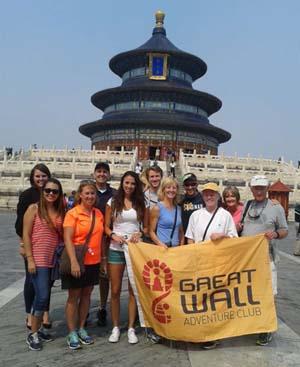
After touring the Forbidden City we will drive to
the Temple of Heaven park, where Ming and Qing
emperors worshipped and prayed for a good and
bountiful harvest. The Temple of Heaven is best
known for its iconic building the Hall of Prayer for
Good Harvests, with its blue triple-gabled circular
roof. It was inscribed as a UNESCO World Heritage
Site in 1988, and was described by that organization
as “a masterpiece of architecture and landscape
design which simply and graphically illustrates a
cosmogony of great importance for the evolution of
one of the worlds great civilizations.”
NOON
We will
have a break for a brief lunch
by tasting the local specialties of Beijing - dumplings,
Chinese quesadilla, noodles
with stir-fried sources, or Qingfeng baozi (meat buns),
a roadside restaurant chain in old Beijing famed for its
succulent steamed buns. Chinese President Xi ordered 6
pork buns and other dishes in this restaurant before and
it has greatly improved the reputation of Qingfeng.
Qingfeng, in Chinese, means "celebrating
the harvest."
AFTERNOON
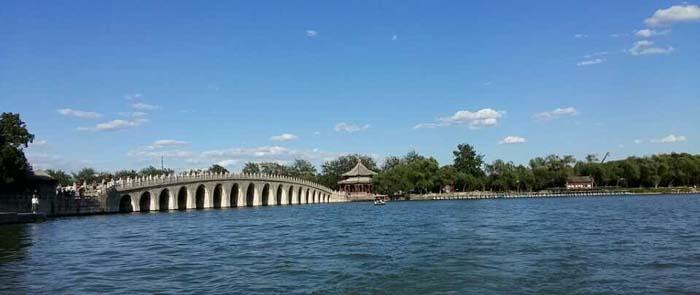
After lunch we will drive to the
Summer Palace, which starts as the Garden of Clear
Ripples in 1750 (under the reign of emperor
Qianlong). The Summer Palace has suffered from two
major attacks, during the Anglo-French invasion of
1860 and during the Bower Rebellion, only to be
rebuilt, and was seen by contemporaries of the late
Qing dynasty as a symbol of extravagance and excess.
The Summer Palace is dominated in the center by Lake
Kunming, built to in imitation of Hangzhou’s West
Lake. Highlights not to be missed are Longevity
Hill, which overlooks the lake and includes the
Tower of Buddhist Incense, the highest building in
the Summer Palace, Suzhou Street, an alley of river
recreated in imitation of the beautiful Chinese city
Suzhou (famed for its canals), and the Marble Boat,
commissioned by Dowager Empress Cixi (with the funds
originally being designated for the Chinese navy).
After exploring the Summer Palace we will drive you
back to your hotel.
Included:
1. Professional English-speaking local guide
& driver;
2. Private air-conditioned
car or van for transportation;
3. General admissions;
4. Lunch and unlimited bottles of spring water.
|
|
 See
other Beijing touring programs. See
other Beijing touring programs.
|