Xian 3-day 2-night
Package Tour

|
|
|
Xian 3-Day & 2-Night Tour
Two Full Days Tour to Terracotta
Warriors, City Wall, Big Wild Goose Pagoda
Enjoy the Famous Dumpling Banquet and the Tang Dynasty Show
Make your own Terra Cotta
Warrior and take it home!
|
|
In March 1974, a group of peasants digging a
well in drought-parched Shaanxi province in
northwest China unearthed fragments of a clay
figure�the first evidence of what would turn out
to be one of the greatest archaeological
discoveries of modern times. Near the
unexcavated tomb of Qin Shi Huangdi�who had
proclaimed himself first emperor of China in 221
B.C.�lay an extraordinary underground treasure:
an entire army of life-size terra cotta soldiers
and horses, interred for more than 2,000 years.
The site, where Qin Shi Huangdi's ancient
capital of Xianyang once stood, lies a half-hour
drive from Xian. It is a dry, scrubby land
planted in persimmon and pomegranate that is
marked by dun-colored hills pocked with caves.
.
Highlights:
� Experience the Terracotta Warriors, Xi�an, and quite
possibly China�s most amazing archaeological discovery
� Make your own Terracotta
Warriors and bring it home!
� Witness the splendor and glory of Xi�an�s past, with
the Tang Dynasty show, which will also included a
dumpling feast
� Take a walk along the ancient city wall, one of the
only ancient city walls in China still standing
B= Breakfast
L= lunch D= dinner
|
| |
TOUR ITINERARY |
 |
Tour
code:
GWAC-XA-02 |
|
DAY 1: ARRIVE IN XI'AN (L, D)
In the morning you will arrive in Xi�an, and your
local English-speaking guide will pick you up either
from the Xi�an airport or train station. For your
accommodation, you will be staying in a 3 or 4 star
hotel, and if you choose the deluxe tour, you will
be lodging at a 5 star hotel. After giving you a
little time to unpack and freshen up, we�ll set out
for Xi�an�s major claim to fame, the Terracotta
Warriors.
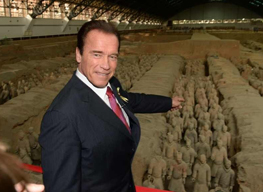
The Terra Cotta Warriors and Horses Museum is the
result of the most significant archeological
excavations of the 20th century. Work is ongoing at
this site, which is around 1.5 kilometers east of
Emperor Qin Shi Huang's Mausoleum. Upon ascending
the throne at the age of 13 (in 246 BC), Qin Shi
Huang, later the first Emperor of all China, had
begun to work for his mausoleum. It took 11 years to
finish. It is speculated that many buried treasures
and sacrificial objects had accompanied the emperor
in his after life. A group of peasants uncovered
some pottery while digging for a well nearby the
royal tomb in 1974. Life size terracotta figures of
warriors and horses arranged in battle formations
are the star features at the museum. They are
replicas of what the imperial guard should look like
in those days of pomp and vigor.
The museum is divided into three sections: No. 1
Pit, No. 2 Pit, and No. 3 Pit respectively. They
were tagged in the order of their discoveries. No. 1
Pit is the largest, first opened to the public on
China's National Day, 1979. There are columns of
soldiers at the front, followed by war chariots at
the back. No. 2 Pit, found in 1976, contains over a
thousand warriors and 90 chariots of wood. It was
unveiled to the public in 1994. Archeologists came
upon No. 3 Pit also in 1976. It is the command
center of the armed forces. It went on display in
1989, with 68 warriors, a war chariot and four
horses.
MAKE YOUR OWN TERRACOTTA WARRIOR! You will have an
opportunity to visit the Terracotta Reproduction
Factory. At the factory, talented craftsmen make
these life size replicas in the same manner as their
counterparts did two thousand years ago - with just
their hands, a few basic tools, and clay. By
watching how a terracotta is made, you can try to
make your own miniature reproduction of the famous
artifact and take it home!
For dinner, you�ll have a real treat in store for
you in the form of a splendid dumpling dinner. Xian,
an ancient city that has been the nation's capital
during no less than eleven dynasties spanning more
than a thousand years is regarded as the home if not
the birthplace of the great dumpling tradition. It
was here that the art of creating the most tasty and
delicate of dumplings was refined and no visit to
the city is complete unless you partake of a
Dumpling Dinner.
This is an experience for the dumpling connoisseur,
the flavors, shapes and colors will tempt the
palette, while the elegant names and stories
attached to each variety are truly amazing. It is no
less amazing that a simple way of preparing food has
become so very popular and sophisticated that it is
now considered to be as much a work of art as a
tasty morsel.
Following dinner, you�ll be treated to an evening of
culture and entertainment in the form of the Tang
Dynasty Music and Dance Show. The Tang Dynasty Music
and Dance Show, a wonderful performance of the
ancient music and dance, is a must when you visit
Xian. The city, which was formerly known as Chang'an
has a very long history, and was the imperial
capital during 13 dynastic periods. Of these, the
Tang Dynasty (618 - 907) was the most prosperous and
glorious of all.
The Tang Dynasty Music and Dance Show is an
outstanding exponent of this ancient stable and
prosperous society, keeping alive its splendid
culture and providing an insight into the peaceful
life style of the period. As an art form, the show
has its roots in folk fetes, when dances were first
performed by people as part of rituals of prayer for
a good harvest or a better life. Combining poetry
with the skilled playing of musical instruments,
singing, dancing and also stunning costumes, the
modern presentation is certain to give you an
impressive view of ancient China including its
splendid history, brilliant arts, distinct
traditions and customs.
|
DAY 2: Xian (B, L)
Following breakfast in the hotel, we�ll get started
we�ll get started with the day�s sightseeing by
taking a stroll on Xi�an�s ancient city wall. It's
the most complete city wall that has survived in
China, as well being one of the largest ancient
military defensive systems in the world. Xi'an City
Wall was erected in the 14th century Ming Dynasty,
under the regime of Emperor Zhu Yuanzhang. When Zhu
Yuanzhang captured Huizhou, long before the
establishment of the Ming Dynasty, he was admonished
by a hermit named Zhu Sheng, who told him to "build
high walls, store abundant provisions and take your
time in proclaiming yourself emperor." If you like,
you have the option of renting a bike or a rickshaw
on the wall in order to cover more ground in a
shorter time.
Then we�ll make the short drive to the Big Wild
Goose Pagoda, a pagoda surrounded by a still
functioning Buddhist temple (named Da Ci�en Temple).
The Big Wild Goose Pagoda is one of the most famous
Buddhist pagodas in China. The Pagoda was built in
the Tang Dynasty (618-907) for the study of Buddhist
scriptures. Although it has been attacked by
centuries of weather, war and seismic activity,
which destroyed most of the original material of the
structure, a pagoda by this name and style still
exists on the site. The Tang regime gave orders to
build a chamber for the translation of Buddhist
scriptures in an effort to have the then widely
renowned Master Xuanzang agree to be the head of the
temple. Xuanzang was a Buddhist monk who traveled to
India, translated Sanskrit scriptures and developed
theories of consciousness, karma and rebirth that
were adopted by some later popular schools of
Buddhism.
The hallowed pagoda is an architectural marvel. It
was built with layers of bricks without any cement.
The bracket style used in traditional Chinese
architecture was also used in the construction of
the pagoda. The seams between each layer of bricks
and the " prisms' on each side of the pagoda are
clearly visible. The grand body of the pagoda with
its solemn appearance, simple style and high
structure, is indeed a good example of Chinese
traditional architecture.
You are free to spend your night at your own
leisure. You might want to start your evening at the
historic city center, the Bell Tower, before going
on to the Muslim Snack Street, which is among the
prime areas of interest in this part of the city.
|
DAY 3: Depart Xian (B, L)
After breakfast in the hotel your guide
will take you to either the Xi�an airport or train
station, and you�ll travel on to your next
destination. If you would like to extend your stay
in Xi�an or your time in China then check with our
China City Tours or China Package tours page to find
out how!
|
|
Tour Inclusions:
1. Hotels with daily western breakfasts;
2. Meals in accordance with that listed on the itinerary.
3. professional local guide & driver;
4. Private air-conditioned car or van for transportation;
5. Admission of the first gate;
6.Two bottles of mineral water per day.
Tour exclusions:
1. Tips to the guide;
2. Personal costs.
 See
other Xian Tour Programs See
other Xian Tour Programs
|
