|
|
2008 Olympics Xian Chinese Legend Tours
Xian - the starting point of the
world-famous Silk Road
Why tour Xian during the
2008 Olympics?
Xi'an was China's
capital for 1,100 years, and other Asian cities such as Seoul, South
Korea, are modeled on its grid-style layout. There are many cultural
relics and historic sites both on and under the ground. One can find a
lot of historic attractions within Xi'an, 34 of which have been listed
among the national monuments, including the remains of Banpo village,
a Neolithic matriarchal clan community, the Museum of Terra Cotta
Warriors and Horses, which is called "'the eighth major miracle of the
world', the mausoleum of the Emperor Qin Shi Huang, which is listed on
"the World Cultural heritages", the Forest of Stone Tablets, which is
called house of the Chinese calligraphic art, the Big Wild Goose pagoda and Small Goose Pagoda, which are the representative
architectures of Xian, City Wall of Ming Dynasty, which is the
grandest and best-preserved classical castle in the world. It is no
wonder that Xian is called "Natural History Museum" . Wild Goose pagoda and Small Goose Pagoda, which are the representative
architectures of Xian, City Wall of Ming Dynasty, which is the
grandest and best-preserved classical castle in the world. It is no
wonder that Xian is called "Natural History Museum" .
In addition ,Xian is also the starting point of the world famous Silk
Road. And the steep and characteristic Mt. Huashan delivers Xian
natural atmosphere. Experiencing the city will give you a chance to
understand amazing Chinese civilization and to enjoy yourself in
Chinese style.
In 1998, in a colorful
display filled with symbolism, U.S. President Clinton received an
official welcome to China in a ceremony at the South Gate of the
ancient city of Xian. At the extravagant welcoming ceremony, the
president was greeted with an old Chinese proverb: "Isn't it a
delight, should friends visit from afar."
Clinton visited one of the
country's most popular tourist sites in the region - the imperial tomb
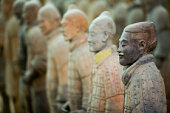
and the Terracotta Warriors. The terra cotta warriors, thousands of life-size figures frozen in
time, are on Xi'an's outskirts. Uncovered in 1974 by farmers digging a
well, the exquisitely molded figures were buried in pits to guard the
spirit of tyrannical emperor Qin Shihuangdi. The first ruler to unify
China, more than 2,000 years ago, Qin had books burned and scholars
buried alive to protect his rule. |
Tourist Attractions of Xian

Terracotta Warriors
In March 1974, villagers of the Xiyang Village,
while welling, found by chance the delves of Emperor Qinshihuang's
Tomb Figures made up of Soldiers and Horses that were buried in
the Yanzhai Village Lintong County. They named them respectively
No.1 Delve, No.2 Delve and No.3 Delve according to the time when
they were founded. The total acreage of delves is 22,780 square
meters. In the No.1 Delve, there are 210 tomb figures in military
suits, arrayed as in the actual combat. In the No.2 Delve, more
than 100 pottery tomb figures are unearthed, and more than 500
horses and carriages are found. And in the No.3 Delve, there are
only 4 horses and 1 carriage and 568 pottery tomb figures.
Finely made and nicely sculpted, Qinshihuang's tomb
figures are high and big, and they're artworks of relatively high
level. Implements ever used in the actual combat numbered in 10
thousands are exhibited in the delves. All kinds of them were
finely made, and they're transcendental artworks. The Museum of
Emperor Qinshihuang's Tomb Figures of Soldiers and Horses are one
of the 10 most famous places in China, and are announced as the
world cultural heritage by UNESCO.
|
 Great
Wild Goose Pagoda Great
Wild Goose Pagoda
At all times, Great Wild Goose
Pagoda id regarded as the masterpiece excelling the Nature. Since
Monk Xuanzang fetched the sutra, the legend has been told all over
the capital.
Great Wild Goose Pagoda spires loftily in the Daci'en Temple. The
temple is in the south suburb of Xi'an, the ancient capital. After
Rabbi Xuanzang, the heir arch of the Tang Dynasty, fetched the
sutra from India, where Buddhism originated, having experienced a
lot of adversity and dangers, the emperor of the Tang Dynasty
welcomed him ceremoniously, and let him preside in the newly built
Daci'en Temple.
In 652 A.D. (the 3rd year of Yonghui Period), Rabbi Xuanzang
presented a memorial to the emperor to build the grand Dayan Tower
for storing up the sutra. It's the sanctum for Rabbi Xuanzang to
translate and explain the sutra of Buddhism, also the place where
Number One Scholars, Jinshi and Juren of the past dynasties
superscripted, and where longhairs and artists wrote poems and
drew pictures. Poets of the Tang Dynasty, such as Dufu, Censen,
baijuyi etc., all stepped on the tower and expressed their
feelings, leaving countless peaks of the poetic perfection,
especially the supernatural tales like "Xi You Ji" (means a
westward joumey) for the later generations to appreciate.
Mounting the grand Dayan Tower, looking into the distance while
leaning on the handrail, you can see the whole ancient city of too
many beautiful things, which makes you relaxed, happy and
reluctant to leave.
|

Qianling (Qian Tomb)
The Qian Tomb was the tomb where
Gaozong Lizhi (628-663A.D.), the third emperor of the Tang
Dynasty, and Wu Zetian (624-704A.D.), the only woman emperor in
Chinese history, were buried together. It's on the Mount Liang, 6
kilometers north of the Qian county, and 80 kilometers away from
the Xi'an City. It was built in 684 A.D., and took 23 years. It
not only had a magnificent appearance, but also stored many
things. As recorded in "Sushengjibei", when Tang Gaozong was
dying, his last words were to bury in tomb all the drawings and
pictures he loved, so there were all kinds of things in the tomb.
|

Xian City Wall and Towers
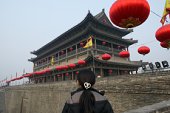
Built between 1370 to 1378 (the Hongwu Era of the Ming
Dynasty), more than 600 years ago from now, the Xi'an
circumvallation of the Ming Dynasty is the most completely
reserved site of ancient circumvallation in our country. Its
perimeter is 13.7 kilometers with earthen cities on each gate of
the city, on which city towers and arrow towers were built.
The west gate is regarded as the jumping off point of the Silk
Road, and in its earthen city, there is a big sweet water well
excavating in the Kangxi Era, on which all people of the Xi'an
city lived before they began to use the tap water. In order to let
the visitors know more about the history of the Xi'an city,
"Exhibition of the History of the Development of the Xi'an City"
is held chronically inside the city tower. It shows people the
historic flux of Xi'an of more than 3000 years with large numbers
of pictures and characters. In addition, temporary exhibitions are
held a periodically. "Zhong jun lei gu tai" (the platform for
beating the military drum) was built beside the city tower,
including a big drum, and exhibitions of all types of archaized
instruments for defending the city.
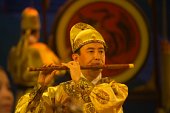
"The Archaized Welcoming Ceremony to the Ancient City" is held
inside the earthen city of the north gate. When the visitors enter
the city, ranks of dagger holding knights in armatures will
welcome them, light holding ladies-in-waiting will blaze a way,
the civilian will present the gold key of the city and the customs
declaration form. The visitors can enjoy the elegant manners of
the culture of more than 1000 years ago by hearing the beautiful
ancient music. The form of the ceremony is of very large scale,
thus attracting thousands of guests from China and foreign
countries.
City towers and arrow towers at the east gate have been repaired
and are appearing new, and will be officially open by the end of
this year. |
|