|
Mount Emei, Leshan Buddha, Panda Base |
|
|
|
Chengdu
Panda Base, Mount Emei, Leshan
Buddha
4 days 3 nights Tour and Hike
Highlights:
� Witness in person the gargantuan and awe-inspiring
heights of the Leshan Buddha, the world�s largest Buddha
statue.
� Get all cute and cuddly with the Giant Panda at the
Chengdu Panda Breeding Research Center, the world�s premier
Panda research and exhibition facility.
� Take a trip down Chengdu's rich and storied past
with a visit to the Wide and Narrow alleys as well as Jinli.
These areas allow you to experience Chengdu's vibrant and
alluring culture while also providing you with scores of
entertainment!
B = breakfast, L= lunch, D = dinner.
|
|
|
| DAY 01 |
Arrive in Chengdu-Mt.
Emei (L, D)
You will either fly or take the train into
Chengdu, the capital of Sichuan province in
southwest China. Upon arrival you’ll be met by
your English-speaking travel guide. After your
arrival we will make the short drive outside of
Chengdu in order to visit Leshan
Buddha and Mt. Emei.
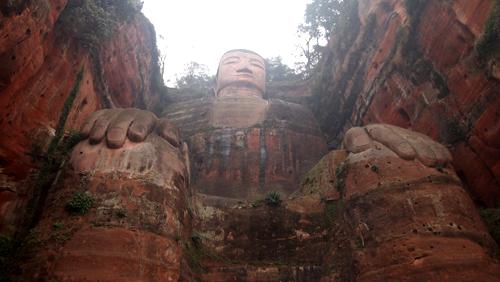
We'll first take a tour to
Leshan Budda. The
largest representation of the Buddha in the
world, the statue is of Maitreya (a Bodhisattva usually
represented as a very stout monk with a broad
smile on his face and with his naked breast and
paunch exposed to view) in sitting posture. The
Buddha is located to the east of Leshan City,
Sichuan Province, at the confluence of three
rivers, namely, Min River, Qingyi River, and
Dadu River. The statue makes itself the most
renowned scenic spot in Leshan City. In
December, 1996, the location of the Buddha was
included by UNESCO on the list of the World
Heritage sites. Begun in the year 713 in the
Tang Dynasty, and finished in the year 803, the
statue took people more than 90 years to carve.
During these years, thousands of workers had
expended their efforts and wisdom on the
project. As the biggest carved stone Buddha in
the world, Leshan Giant Buddha is featured in
poetry, song and story. Our visit to the Leshan
Buddha will be complete with a river cruise,
giving you a glorious vantage point (and photo
op!) of which to view the Buddha.
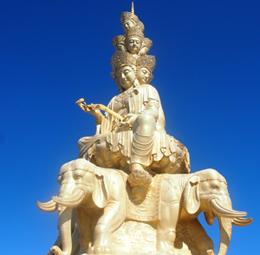 Following the Leshan tour, we go to Mount Emei.
Emei is one of the most well-known summer
destinations in China thanks to its pleasant
weather, congenial atmosphere, the inspiring
natural scenery and the influence of the
Buddhist culture. The mountain is characterized
by lofty ancient trees, impressive waterfalls,
pristine brooks and numerous Buddhist temples.
Mt. Emei is a sacred Buddhist haven. It is one
of the four most divine Buddhist mountains in
China. This Buddhist legacy mainly contained in
the numerous temples and the buildings bears
witness to the unusual historical role of the
mountain in Buddhism development since the
religion was introduced to China over 2,000
years ago. Following the Leshan tour, we go to Mount Emei.
Emei is one of the most well-known summer
destinations in China thanks to its pleasant
weather, congenial atmosphere, the inspiring
natural scenery and the influence of the
Buddhist culture. The mountain is characterized
by lofty ancient trees, impressive waterfalls,
pristine brooks and numerous Buddhist temples.
Mt. Emei is a sacred Buddhist haven. It is one
of the four most divine Buddhist mountains in
China. This Buddhist legacy mainly contained in
the numerous temples and the buildings bears
witness to the unusual historical role of the
mountain in Buddhism development since the
religion was introduced to China over 2,000
years ago.
After we arrive we will first go on over to the
Baogou temple, which is located at the foot of
Mt. Emei. The temple was built during the years
of Wanli period in the Ming Dynasty. The
horizontal tablet of "Baoguo Temple" was written
by Emperor Kangxi of the Qing Dynasty. It is the
place where the Mt. Emei Buddhist Society is
located. The Baoguo Temple is originally named
Huizong Hall, which has the meaning of blending
the three religions of Buddhism, Taoism and
Confucianism into one. Emperor Kangxi of the
Qing Dynasty granted the name of "Baoguo
Temple", which adopts the meaning that
dedicating to the service of the country comes
first in "repaying four kindness" in the sutra.
We will then spend the evening at an inn near
Mt. Emei.
|
|
| DAY 02 |
Mt. Emei-Chengdu
(B, L)
Following breakfast we’ll set out to explore
more of Mt. Emei. Here is some of the highlights
you’ll find:
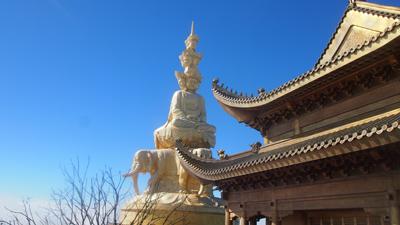
Gold Summit: The number of the Buddhist temples
dotting the mountain is quite inspiring but the
views from the Golden Summit at an elevation of
3,077 meters above sea level steals the glory.
The Gold Summit is an extravagance of natural
wonders and Buddhism spiritualism, which
comprise of four marvelous spectacles of
Sunrise, Cloud Sea, Buddhist Light and sacred
lamp. The scenery of a red glowing sun dancing
over the sea of clouds in the east is fabulous.
A few lucky visitors will encounter the Buddhist
Light which only occurs 14 times a year. On
these occasions, your shadow is cast before you
in the mist and a colorfully glowing lights
circle you as if you are attained enlightenment.
Fuhu Temple: At the foot of Fuhu Hill, Fuhu
Temple is located one kilometer west of Baoguo
Temple and is one of the largest in the
mountain area. It was rebuilt in 1651, the
eighth year of the reign of Qing Emperor Shunzhi.
It covers an area of 13,000 square meters and
isaccessible from the highway. "Crouching Tiger
Monastery", as it is known in Chinese, is sunk
in the forest. Inside is a seven-meter-high
copper pagoda inscribed with Buddhist images and
texts. Fuhu Temple, the biggest Buddhist temple
on the mountain, has 13 halls. In the temple, a
6-meter 17-storeyed bronze tower made in the
Yuan Dynasty(1271-1368) has some 4,700 engraved
Buddhist figurines on it. The 20,000-character
Huayan Sutras are well preserved in the temple.
In the late afternoon you’ll be driven back to
Chengdu, and you’ll be able to spend the night
at your own leisure. From traditional teahouses,
theaters to modern pubs and clubs, Chengdu
people know how to enjoy the night. Every corner
in Chengdu offers the warmest welcome, and you
are sure to find something to pique your
interest during your time on the town.
|
| DAY 03 |
Chengdu Panda Base (B, L)
Today will be a full day of touring within the city of
Chengdu. After breakfast, we�ll get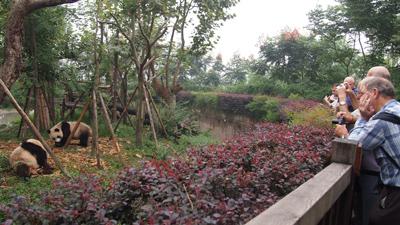 started with a visit to Chengdu's premier attraction,
the Giant Panda Breeding Research
Base.. The Panda Breeding Research Center has been
created and imitated the pandas' natural habitat in
order that they might have the best possible environment
for rearing and breeding. It cares also for other rare
and endangered wild animals with an area of 560 mus (92
acres), 96% of which is verdure. Giant pandas, lesser
pandas, black-necked cranes, white storks as well as
over 20 species of rare animals are fed and bred there
throughout the year. Verdant bamboo, bright flowers,
fresh air, a natural hill scene and a beautiful
artificial view are merged ingeniously at the base.
started with a visit to Chengdu's premier attraction,
the Giant Panda Breeding Research
Base.. The Panda Breeding Research Center has been
created and imitated the pandas' natural habitat in
order that they might have the best possible environment
for rearing and breeding. It cares also for other rare
and endangered wild animals with an area of 560 mus (92
acres), 96% of which is verdure. Giant pandas, lesser
pandas, black-necked cranes, white storks as well as
over 20 species of rare animals are fed and bred there
throughout the year. Verdant bamboo, bright flowers,
fresh air, a natural hill scene and a beautiful
artificial view are merged ingeniously at the base.
The Giant Panda Museum was opened in 1993 to further
scientific education and to improve public awareness of
the protection of both wild creatures and their
environment. This is the world's only thematic museum
for rare and endangered animal species. The three main
exhibitions are in the Giant Panda Hall, the Butterfly
Hall and the Vertebrate Hall. The exhibits include all
kinds of precious pictures, more than 800 materials and
show more than 2140 different samples gathered in
Sichuan. These include examples of animals, birds,
amphibians, reptiles and insects as well as fossils and
models. The resources held in store at the museum
include up to ten thousand samples as well as a library
of thousands of books and documents. This excellent and
comprehensive museum provides a wonderful venue for all
who are interested in seeing something of the
propagation and protection of the region's natural
bio-diversity.
 The necessary facilities for giant pandas have been
completed and include a fodder room, sleeping quarters
and a medical station. Additionally there is a Giant
Panda Museum together with research laboratories and a
training center. A great number of plants and as many as
ten thousand clumps of bamboos and bushes have been
cultivated to provide for the giant pandas' diet and
habitat. The center is planned to be expanded by another
3000 mus (500 acres) of land on which to simulate a
natural environment order to prepare the giant pandas
bred for release into the wild. The necessary facilities for giant pandas have been
completed and include a fodder room, sleeping quarters
and a medical station. Additionally there is a Giant
Panda Museum together with research laboratories and a
training center. A great number of plants and as many as
ten thousand clumps of bamboos and bushes have been
cultivated to provide for the giant pandas' diet and
habitat. The center is planned to be expanded by another
3000 mus (500 acres) of land on which to simulate a
natural environment order to prepare the giant pandas
bred for release into the wild.
Following our time at the Panda base and a Chinese
lunch, we'll next drive over to the wide and narrow
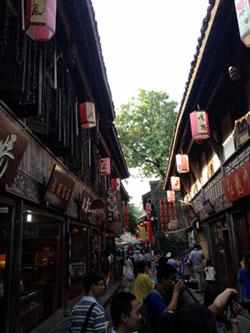
alleys (Kuai Zhai Xiangzi), which are two ancient
streets constructed in the architectural styles of the
Ming (1368-1644) and Qing (1644-1911) dynasties.They
represent a condensed history of Chengdu, combining both
history and modern changes.
The wide and narrow alleys, along with Daci Monastery
and Wenshu Monastery, consist of three famous historical
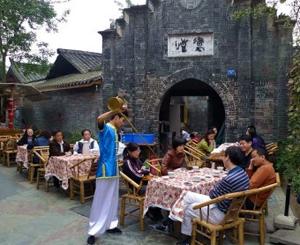
relics in Chengdu. A visit to the alleys, visitors can
experience the leisurely and comfortable life in Chengdu
with boutique hotels, characteristic local snacks and
cuisines, traditional teahouse, distinctive inns and
relaxing Spas. The historical and cultural area of the
wide and narrow alleys is consists of wide alley, narrow
alley, jing (well) alley and quadrangle courtyards.The
wide alley was called Xingren Lane during the Qing
Dynasty (1644�1911), and it is the representative of
Chengdu folk culture, with the theme is travel and
leisure. Featuring boutique hotels, unique restaurants
in folk styles, traditional teahouses, taverns and
distinctive inns, the alley provides visitors an
opportunity to experience the life of old Chengdu.
Walking across the south-north passageway of the wide
alley, visitors reach the narrow alley which was called
Taiping Lane during Qing Dynasty (1644�1911). There are
western food, Coffee, retails and themed culture salon
in the courtyard and the long alley. Decorated with
elegant ambience of fashion in German, Japanese,
American, French, Indian styles, the narrow alley really
reflects the slow life in Chengdu and is a great place
to spend the afternoon.
 Following
our stroll down the wide and narrow alleys, we'll head
to the nearby street of Jinli. Jinli Street is
particularly representative of this city. It is recorded
that as early as the Qin Dynasty (221 BC - 206 BC),
Jinli Street was the most famous place for baldachin - a
rich, ornate cloth. And it was one of the busiest
commercial areas during the Shu Kingdom (221-263).
Hence, it is known as 'First Street of the Shu Kingdom'.
Jinli Street is particularly representative of Chengdu.
It is recorded that as early as the Qin Dynasty (221 BC
- 206 BC), Jinli Street was the most famous place for
baldachin - a rich, ornate cloth. And it was one of the
busiest commercial areas during the Shu Kingdom
(221-263). Hence, it is known as 'First Street of the
Shu Kingdom'. In order to reclaim its prosperity of
former days, it was restored with contributions from the
Wuhou Memorial Temple and was opened to public in
October of 2004. Since then, visitors from all over
China and abroad gather here to relax, admire the
traditional-style buildings, and taste some local
snacks. In the middle of the street, there is a wooden
stage which looks like an ancient pavilion. It is used
from time to time for performing classic Sichuan Operas.
You can enjoy folk music along with the actor's
beautiful, quick costume and make-up changes. The
actors' perfect performances will wow you. Open-air
movies are also shown in front of the stage. Following
our stroll down the wide and narrow alleys, we'll head
to the nearby street of Jinli. Jinli Street is
particularly representative of this city. It is recorded
that as early as the Qin Dynasty (221 BC - 206 BC),
Jinli Street was the most famous place for baldachin - a
rich, ornate cloth. And it was one of the busiest
commercial areas during the Shu Kingdom (221-263).
Hence, it is known as 'First Street of the Shu Kingdom'.
Jinli Street is particularly representative of Chengdu.
It is recorded that as early as the Qin Dynasty (221 BC
- 206 BC), Jinli Street was the most famous place for
baldachin - a rich, ornate cloth. And it was one of the
busiest commercial areas during the Shu Kingdom
(221-263). Hence, it is known as 'First Street of the
Shu Kingdom'. In order to reclaim its prosperity of
former days, it was restored with contributions from the
Wuhou Memorial Temple and was opened to public in
October of 2004. Since then, visitors from all over
China and abroad gather here to relax, admire the
traditional-style buildings, and taste some local
snacks. In the middle of the street, there is a wooden
stage which looks like an ancient pavilion. It is used
from time to time for performing classic Sichuan Operas.
You can enjoy folk music along with the actor's
beautiful, quick costume and make-up changes. The
actors' perfect performances will wow you. Open-air
movies are also shown in front of the stage.
Following our time in Jinli you�ll then be taken back to
your hotel, where you can spend the rest of your night
at your own discretion.
|
|
| DAY 04 |
Chengdu-depart (B)
After breakfast in the hotel, you will be taken
to either the airport or the train station, and
you will depart for your next destination.
|
|
|
Tour Inclusions:
1. Hotels with daily western
breakfasts;
2. Meals in accordance with
that listed on the itinerary.
3. professional local guide
& driver;
4. Private air-conditioned
car or van for transportation;
5. Admission of the first
gate.
6. Two bottles of mineral
water per day.
Tour exclusions:
1. Tip of the guide
2. Personal costs
|
